Praiser
iOS and web platform for logging and visualizing chronic pain.
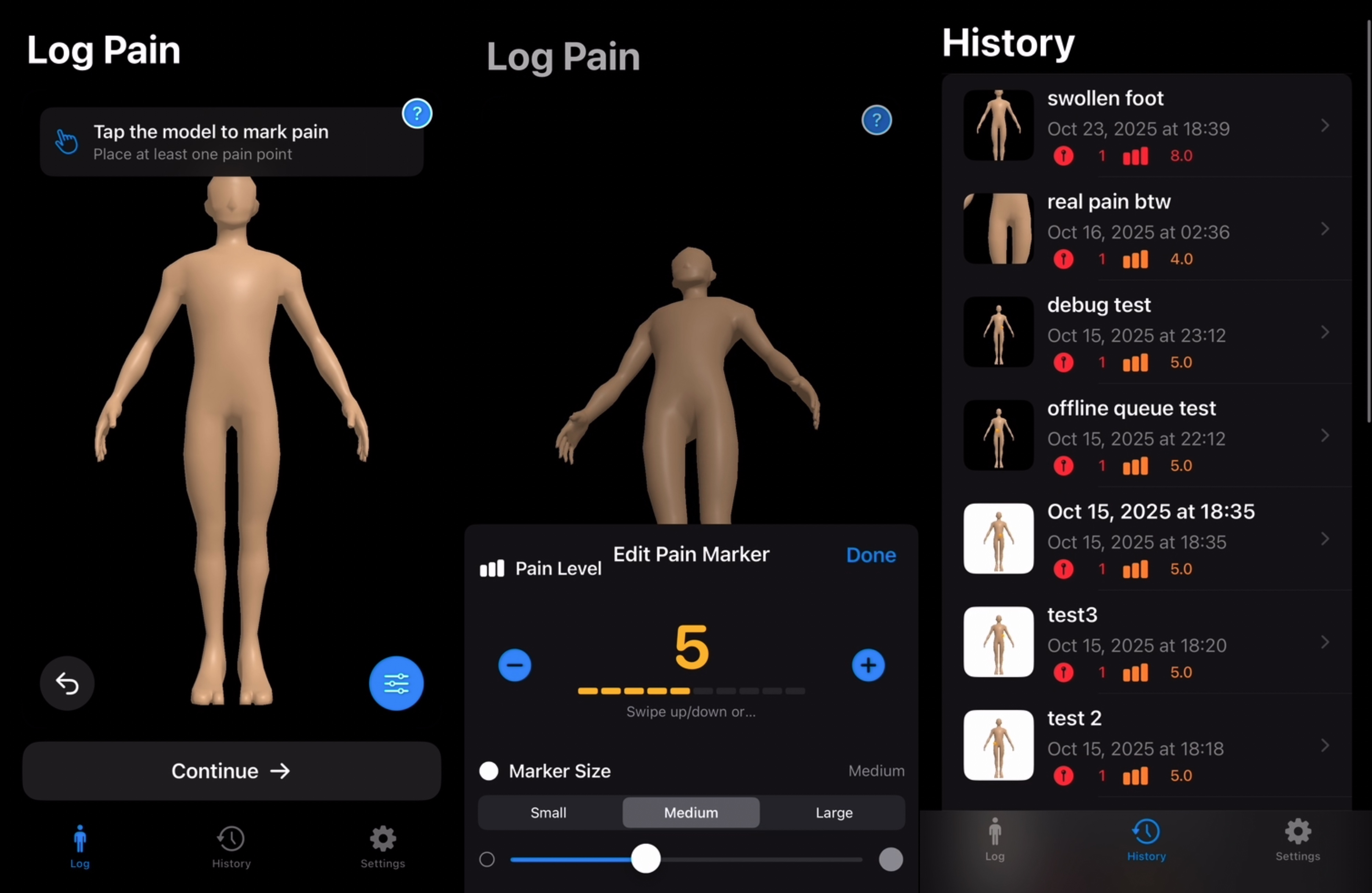
overview
iOS app uses SceneKit for 3D pain point placement on a human body model. Web app built with Next.js using server-side rendering, Three.js for 3D visualization, and Supabase for auth and data. Express API serves as middleware between iOS and Supabase. Hosted on Cloudflare Tunnel.
challenges
- Building an intuitive 3D body model for pain point placement on mobile
- Keeping pain data in sync across iOS and web with offline support
- Migrating the web app from client-side to server-side rendering
- Designing a doctor-patient workflow with role-based access
solutions
- SceneKit with quaternion-based trackball rotation, axis-locking, and haptic feedback
- Offline sync queue with automatic retry using Network framework, Supabase for real-time sync
- Hybrid RSC + client component architecture, modularized data layer for tree-shaking
- Supabase Auth with invite flow, RLS policies, and server-side permission checks
learnings
- SceneKit 3D interaction — quaternion rotation, gesture handling, sphere placement
- SwiftUI architecture patterns — @EnvironmentObject, dependency injection
- Next.js SSR migration — hybrid RSC + client components
- Three.js 3D visualization in React
- Supabase Auth with role-based access and RLS policies
- Offline-first patterns with sync queues
future
- Revive as a simplified logging-only app
Contributions#
iOS
- 3D body model with SceneKit — trackball rotation, axis-locking, sphere placement/editing
- Full UI redesign following Apple HIG (auth, tabs, pain log, history, settings)
- Offline sync queue with automatic retry
- Architecture refactor to proper SwiftUI patterns
Web
- Next.js app with SSR migration from client-side rendering
- Three.js 3D pain visualization
- Sidebar navigation, theming, doctor invite flow
- Modularized data layer and API cleanup
- Database schema design for pain sessions
API
- Express server with session/user routes and auth middleware
Infrastructure
- Cloudflare Tunnel hosting
- Supabase configuration and RLS policies